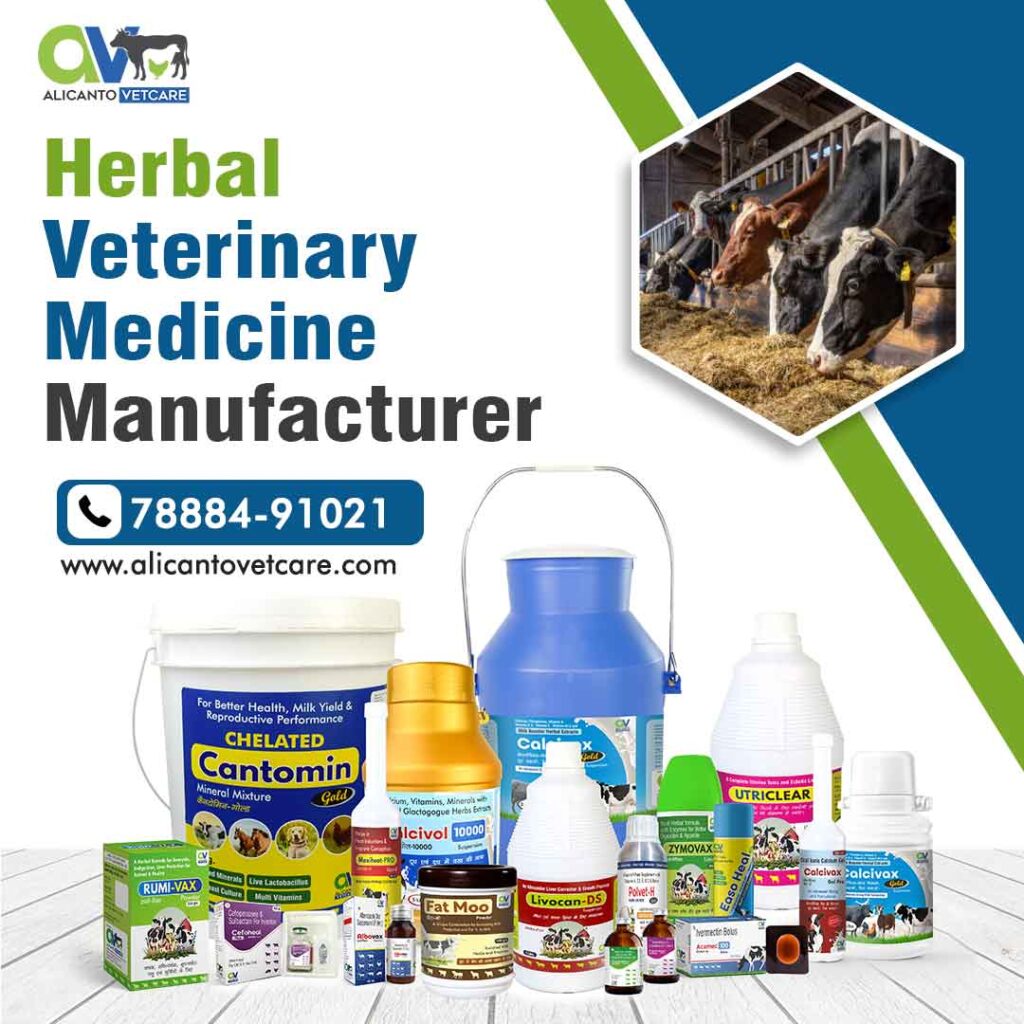
Top Animal Healthcare Products Manufacturing Companies in India
India’s animal healthcare sector is no longer a quiet corner of the pharmaceutical world. It is a fast-moving, quality-driven industry serving dairy farmers, poultry integrators, pet parents, and veterinary clinics across the country. Whether you are a distributor looking for a reliable animal healthcare products manufacturer, an entrepreneur exploring a veterinary PCD franchise, or a brand owner seeking third-party veterinary manufacturing, understanding who makes what — and how — is the first step toward a sound business decision. This guide walks through the industry landscape, the leading players, the quality benchmarks that matter, and the practical criteria for choosing a manufacturing partner, with Alicanto Vetcare as a reference point for what a modern, certification-backed animal healthcare company in India looks like.
What Do Animal Healthcare Products Manufacturing Companies Produce?
The product universe of a veterinary products manufacturing company is broader than many distributors realise. It spans therapeutic pharmaceuticals, biologicals, nutritional and feed additives, and diagnostics, each with distinct manufacturing, storage, and regulatory requirements. The table below maps the major categories and what they typically include.
| Product category | Representative products | Primary species | Manufacturing notes |
|---|---|---|---|
| Vaccines & biologicals | FMD, brucellosis, PPR, Marek’s disease, rabies vaccines | Cattle, poultry, sheep, goats, companion animals | Cold-chain dependent; BSL and sterile filling capabilities required |
| Anti-infectives & antibiotics | Enrofloxacin, oxytetracycline, broad-spectrum antibacterial formulations | Livestock, poultry, pets | Requires validated sterility and potency testing |
| Antiparasitics & dewormers | Albendazole suspensions, ivermectin boluses and injections, tick and flea products | Cattle, sheep, goats, pets | Dosage-form flexibility across oral, injectable, and topical |
| Nutritional & feed supplements | Calcium and mineral mixtures, liver tonics, multivitamins, electrolytes, probiotics | Dairy cattle, poultry, pets | Often formulated as powders, liquids, gels, or feed additives |
| Topicals & wound care | Sprays, ointments, spot-on formulations, medicated shampoos | Companion animals, livestock | Requires stability testing for skin-contact formulations |
| Injectables | Sterile liquid vials, dry injections, pre-filled solutions | All species | Aseptic processing, highest quality-assurance burden |
| Diagnostics & ancillary | Rapid test kits, reagents, diagnostic consumables | All species | Increasingly integrated with digital herd-management platforms |
A capable animal health product manufacturer in India will typically cover multiple dosage forms — boluses, oral liquids, dry and liquid injections, topical preparations, and wound-healing sprays — rather than specialising narrowly. This breadth matters because distributors and franchise partners increasingly prefer a single source that can supply a mixed catalogue across livestock, poultry, and companion-animal segments.
Top Animal Healthcare Products Manufacturers in India
The Indian market is a mix of multinational innovators, large domestic biologicals players, and a vibrant tier of PCD and contract manufacturers. The table below brings together the most frequently cited names, their broad positioning, and the segment they are best known for.
| Company | Type / positioning | Notable strengths |
|---|---|---|
| Alicanto Vetcare | Domestic PCD and contract manufacturer | ISO, GMP, and WHO-credited; 120+ veterinary products; boluses, injections, oral liquids, topicals, and sprays |
| Boehringer Ingelheim Animal Health | Multinational innovator | Poultry vaccines (including next-generation Marek’s disease vaccine announced in 2024), swine and companion animal portfolios |
| Merck Animal Health (MSD) | Multinational innovator | Vaccine depth, aqua health (acquired Elanco’s aqua business in 2024), Intervet India operations in Pune |
| Elanco Animal Health | Multinational | Broad therapeutic and preventive portfolio across species |
| Virbac Animal Health India | Multinational specialist | Parasiticides, anti-infectives, feed supplements, topicals, vaccines across livestock, companion animals, and aquaculture |
| Hester Biosciences | Domestic biologicals leader | Poultry, cattle, sheep, and goat vaccines; diagnostics; export presence across Africa and Asia |
| Indian Immunologicals Ltd (IIL) | Domestic biologicals major | Large-scale veterinary and human biologicals; WHO-GMP and BSL-3 facilities; contract manufacturing and R&D collaborations |
| Veko Care | Domestic GMP exporter | EU-GMP, APVMA (Australia), and WHO-GMP approvals; cattle, poultry, companion animal treatments across 70+ countries |
| Zydus Animal Health | Domestic diversified | Multispecies healthcare products and formulations |
| Venky’s India | Domestic poultry specialist | Poultry healthcare products and nutrition |
| Zoetis India | Multinational innovator Companion | animal therapeutics, diagnostics, digital workflow tools; expanded Hyderabad capability centre in 2024 |
For buyers evaluating animal health product manufacturers in India, the practical takeaway is that the “top” list is not monolithic. Multinationals lead on innovation and global documentation; domestic biologicals players lead on vaccine scale and public-programme readiness; and agile PCD-focused manufacturers lead on accessibility, monopoly rights, and launch speed for new brands. Alicanto Vetcare, based in Panchkula, Haryana, sits firmly in this third category — a veterinary products manufacturing company built around a franchise and partnership model rather than a multinational’s direct-to-clinic sales force.
Leading Veterinary Medicine Manufacturing Companies
When the lens shifts specifically to veterinary medicine manufacturing companies — those whose core output is finished dosage forms rather than vaccines alone — the competitive set looks slightly different. This group includes dedicated veterinary formulation houses, contract manufacturers, and PCD specialists whose catalogues run from dewormers and antibiotics to supplements and topicals.
Some of the names that recur in industry listings include Oxi Pharma (Dehradun), with over 22 years of veterinary manufacturing experience and a catalogue exceeding 2,500 formulations; PetVet Healthcare (Ambala Cantt), a WHO-GMP certified manufacturer of injections, boluses, and feed supplements; Vetwin Healthcare (Chandigarh), focused on oral liquids, boluses, and nutritional powders; and Vetina Healthcare (Pune), which offers third-party manufacturing, private-label packaging, and batch testing. Hester Biosciences appears here as well, though its centre of gravity is biologicals.
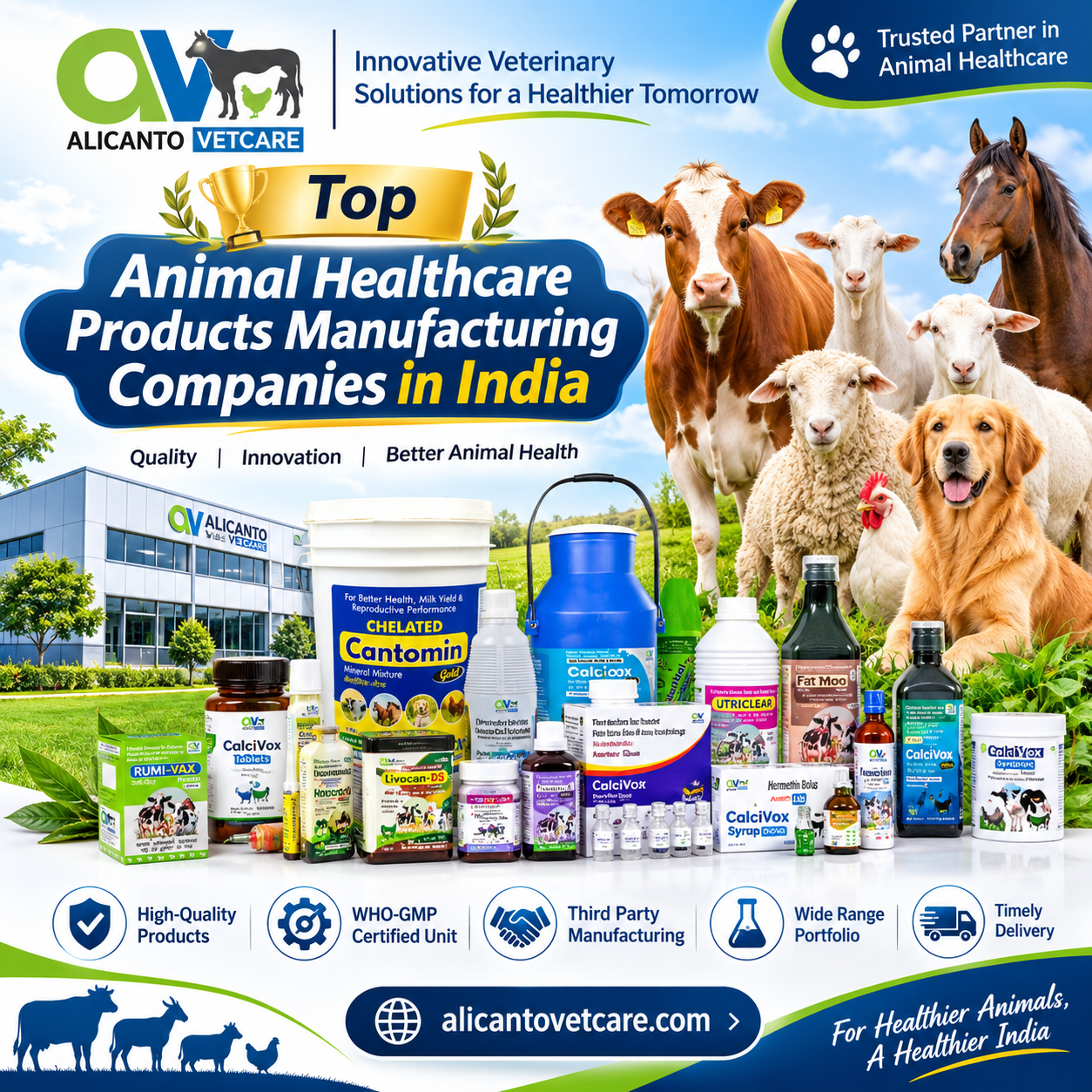
Alicanto Vetcare is repeatedly listed among WHO-GMP certified veterinary companies and PCD-focused manufacturers. Its portfolio spans boluses, liquid and dry injections, oral liquids, topical preparations, and wound-healing sprays, with over 120 quality veterinary products supplied under ISO, GMP, and WHO accreditations. For a veterinary medicine manufacturer in India operating on a partnership model, that combination — breadth of dosage forms, documented certifications, and a franchise-friendly structure — is the core value proposition.
What distinguishes the leading veterinary pharmaceutical manufacturers from the rest is not simply product count. It is the ability to document quality batch after batch, to support distributors with regulatory paperwork, and to maintain formulation consistency when a partner scales from a trial order to a multi-state rollout.
How Veterinary Pharmaceutical Manufacturers Ensure Product Quality
Quality in veterinary pharmaceuticals is not a single certificate on a wall. It is a chain of controls that runs from raw-material sourcing through production, testing, release, and post-market surveillance. For veterinary pharmaceutical manufacturers in India, the regulatory backbone is Schedule M of the Drugs and Cosmetics Rules, increasingly aligned with WHO-GMP principles and, for veterinary products, OIE guideline mapping.
A robust quality system typically rests on five pillars:
1. GMP-compliant facilities and process validation. Cleanrooms, validated equipment, controlled utilities, and documented procedures form the baseline. Leading manufacturers conduct regular internal and third-party GMP audits rather than waiting for a regulator to find gaps.
2. Raw-material and API control. Every active pharmaceutical ingredient and excipient should be tested against specifications before release to production. The strongest manufacturers maintain qualified supplier lists and incoming-testing protocols that catch variability before it reaches a batch.
3. Batch testing and release. No batch should leave the plant without analytical verification of identity, potency, uniformity, and, where applicable, sterility and endotoxin levels. Third-party testing is common for specialised assays.
4. Documentation and traceability. Batch records, deviation reports, change controls, and stability data must be audit-ready. Institutional buyers and export customers increasingly ask for traceability that links a finished product back to its raw-material lots.
5. Pharmacovigilance and complaint handling. Even the best formulation can encounter field issues. A credible animal healthcare company in India will have a structured adverse-event reporting and complaint-investigation process, with corrective and preventive actions fed back into production.
Alicanto Vetcare’s quality positioning rests on its ISO, GMP, and WHO accreditations, which are the three credentials most commonly requested by distributors and franchise partners in the Indian veterinary PCD space. For a partner evaluating a manufacturer, the right question is not “do you have certificates?” but “can you show me the batch records, the stability data, and the last internal audit report behind them?”
Key Animal Health Products for Pets and Livestock
The product mix a manufacturer offers should match the species and therapeutic priorities of its target market. In India, livestock and poultry still dominate volume, but companion-animal products are the fastest-growing value segment. The table below summarises the key product families by species group and the problems they address.
| Species group | Priority health needs | Key product families |
|---|---|---|
| Dairy cattle and buffalo | Mastitis, metabolic disorders, internal parasites, mineral deficiency, FMD | Intramammary preparations, calcium and mineral supplements, dewormers, liver tonics, FMD vaccines |
| Poultry | Respiratory disease, coccidiosis, viral outbreaks (Marek’s, Newcastle), gut health | Vaccines, anticoccidials, antibiotics, probiotics and gut-health additives, electrolytes |
| Sheep and goats | PPR, goat pox, gastrointestinal nematodes, trace-mineral deficiency | Vaccines, anthelmintics, mineral mixtures, boluses |
| Companion animals (dogs, cats) | Parasitic infections, skin and coat conditions, joint health, pain management, vaccination | Dewormers, tick and flea spot-ons, medicated shampoos, joint supplements, analgesics, rabies and combination vaccines |
| Aquaculture | Bacterial infections, water-quality stress, growth performance | Medicated feed additives, disinfectants, probiotics, water conditioners |
The market data reinforces where demand is concentrated: anti-bacterials, anticoccidials, dewormers, nutritional supplements, liver tonics, and vaccines together represent the bulk of product-type segmentation in India. A manufacturer that can supply across several of these families — rather than one narrow therapeutic silo — gives distributors and franchise partners the flexibility to serve mixed rural and urban customer bases.
How to Choose a Veterinary Products Manufacturing Company
Choosing a manufacturing partner is one of the highest-leverage decisions a veterinary brand or distributor will make. The wrong choice shows up months later as batch failures, regulatory friction, or margin erosion. The right choice compounds quietly: consistent quality, repeat orders, and a reputation that travels.
A practical evaluation framework uses five weighted criteria.
| Criterion | What to verify | Why it matters |
|---|---|---|
| Certifications and licences | Valid WHO-GMP, ISO 9001, GMP, and drug manufacturing licence; DCGI approvals where applicable | Baseline eligibility for institutional and export buyers; non-negotiable for serious partners |
| Product-range fit | Dosage forms (boluses, injectables, oral liquids, topicals) and species coverage aligned with your market | Reduces dependence on multiple suppliers and simplifies catalogue management |
| Quality documentation | Batch records, stability data, COAs, internal audit reports, deviation history | Certificates alone do not prove batch-to-batch consistency |
| Commercial terms | MOQs, packaging options, lead times, monopoly rights (in PCD models) | Determines working-capital efficiency and launch speed |
| Track record and support | Existing partner references, field-complaint handling, marketing and regulatory assistance | Predicts what happens after the first order, not just before it |
A site visit is strongly recommended before committing. Hygiene, equipment condition, segregation of sterile and non-sterile areas, and the competence of the quality team are difficult to judge from a brochure. It is also worth asking specifically about experience with your target species and dosage form — a manufacturer strong in poultry feed supplements may not be the best partner for sterile companion-animal injectables.
For entrepreneurs exploring a veterinary PCD franchise, the commercial model adds another layer. Monopoly rights for a defined territory, marketing support, and a product portfolio that matches local demand patterns are often as important as the manufacturing certifications themselves. Alicanto Vetcare’s model is built around these franchise-partner requirements — monopoly rights, a catalogue of over 120 products, and ISO, GMP, and WHO accreditations — which is why it appears in PCD-focused company lists alongside larger national players.
Certifications to Check Before Choosing a Veterinary Pharmaceutical Manufacturer
Certifications are not interchangeable, and not every badge means the same thing. The table below explains the credentials a veterinary products manufacturing company in India should be able to produce, and what each one actually signals.
| Certification / approval | Issuing or governing body | What it demonstrates |
|---|---|---|
| WHO-GMP | World Health Organization Good Manufacturing Practices framework, implemented through national regulators | Manufacturing and quality systems meet international GMP benchmarks; often mandatory for exports |
| GMP / Schedule M compliance | CDSCO and state FDA under the Drugs and Cosmetics Rules | Compliance with India’s national good manufacturing practice requirements, increasingly aligned with WHO/OIE guidance |
| ISO 9001:2015 | International Organization for Standardization | A documented quality management system covering process control, customer focus, and continual improvement |
| ISO 22000 | ISO | Food-safety management, particularly relevant for feed additives and nutritional products |
| EU-GMP | European Medicines Agency / EU competent authorities | Facility approved to European GMP standards — a strong signal of export readiness and inspection maturity |
| Drug manufacturing licence | State FDA / CDSCO | Legal authorisation to manufacture veterinary drugs in India; the foundational licence without which other certificates are meaningless |
| DCGI approvals | Central Drugs Standard Control Organisation | Product-level approvals for formulations requiring central clearance; frequently requested by franchise partners |
Two practical cautions apply. First, verify validity dates and scope — a WHO-GMP certificate for one dosage form does not automatically cover another. Second, ask for the underlying inspection report or audit summary, not just the certificate image. A manufacturer confident in its systems will share more than a logo.
Third-Party Veterinary Manufacturing: What to Know
Third-party veterinary manufacturing — also called contract manufacturing or, in its broader form, CDMO — allows a brand owner, distributor, or startup to launch a veterinary product line without building a factory. The manufacturer formulates, produces, tests, and packs to the brand’s specification or to a standard formulation, and the brand markets the product under its own label. Private-label and PCD models are close cousins of this arrangement.
The appeal is straightforward: lower capital expenditure, faster time to market, access to established quality systems, and the ability to test demand before committing to owned capacity. India’s contract manufacturing ecosystem spans dedicated veterinary players, human-pharma units with veterinary divisions, and specialised injectable manufacturers offering dossier support and product-registration assistance for export markets.
But third-party manufacturing is not a shortcut around quality. The brand owner remains the marketing authorisation holder in most arrangements and carries reputational — and often regulatory — responsibility for the product. The following checklist helps structure the engagement:
-
Define the quality agreement in writing. Specify who tests what, who releases batches, who holds stability data, and how deviations and recalls are handled.
-
Inspect the facility before signing. Verify the specific production line and dosage form you intend to use, not just the site’s general certification.
-
Clarify intellectual-property and formulation ownership. In PCD and private-label models, exclusivity and formulation rights should be documented.
-
Agree on documentation deliverables. COAs, batch records, stability summaries, and regulatory dossiers (where needed) should be listed as contractual outputs.
-
Plan for scale. Confirm that the manufacturer’s capacity and raw-material sourcing can support your growth without compromising lead times.
Alicanto Vetcare operates both as a PCD franchise provider and a third-party manufacturing partner, which means its commercial structure is designed around brand owners who need a launch-ready portfolio rather than a bespoke development programme. For a first-time veterinary entrepreneur, that model reduces the formulation and regulatory burden while keeping the brand-building upside with the partner.
FAQs About Animal Healthcare Products Manufacturing Companies in India
1) Which are the top animal healthcare products manufacturers in India?
The market includes multinationals such as Zoetis, Boehringer Ingelheim, Merck Animal Health, Elanco, and Virbac; domestic biologicals leaders such as Hester Biosciences and Indian Immunologicals; and PCD and contract manufacturers such as Alicanto Vetcare, Oxi Pharma, PetVet Healthcare, and Vetina Healthcare. The right “top” company depends on whether you need vaccine scale, companion-animal innovation, or franchise-ready formulations.
2) What is the difference between a veterinary healthcare products manufacturer and a veterinary pharmaceutical manufacturer?
The terms overlap heavily. “Veterinary healthcare products” is the broader category and includes vaccines, nutritional supplements, feed additives, topicals, and diagnostics alongside pharmaceuticals. A veterinary pharmaceutical manufacturer typically focuses on finished dosage forms — antibiotics, antiparasitics, injectables, and similar therapeutic products.
3) Are WHO-GMP and ISO certifications mandatory for veterinary manufacturers in India?
GMP compliance under Schedule M is a legal requirement for drug manufacturing. WHO-GMP certification is not always mandatory for domestic sale but is effectively required for exports and is routinely requested by distributors, institutional buyers, and franchise partners. ISO 9001 signals a documented quality management system and is a useful additional filter.
4) Can I start a veterinary brand without owning a manufacturing facility?
Yes. Third-party manufacturing and PCD franchise models are designed for exactly this purpose. You select a certified manufacturer, agree on the product portfolio and territory, and market under your own brand. The key diligence is on the manufacturer’s quality systems, not on your own factory floor.
5) What should I check before signing a third-party veterinary manufacturing agreement?
Verify the manufacturing license and certification scope, inspect the facility and the specific production line, review batch-testing and stability protocols, confirm MOQs and lead times, document formulation and exclusivity rights, and establish a written quality agreement covering deviations, complaints, and recalls.
6) How large is the Indian animal healthcare market?
Estimates vary by scope, but the India animal health market was around INR 92.62 billion in 2025, projected to reach INR 171.91 billion by 2034 at roughly 7.11% CAGR. Broader animal health and veterinary care estimates place the 2025 market at USD 2.29 billion, growing to USD 3.91 billion by 2031.
7) Does Alicanto Vetcare offer third-party manufacturing and PCD franchise opportunities?
Yes. Alicanto Vetcare, a unit of Alicanto Drugs based in Panchkula, Haryana, operates a PCD franchise and third-party manufacturing model with a portfolio of over 120 veterinary products across boluses, injections, oral liquids, topicals, and sprays, backed by ISO, GMP, and WHO accreditations.
India’s animal healthcare industry rewards partners who take quality documentation seriously and choose manufacturers whose product range, certifications, and commercial model align with their growth plan. Whether you are comparing animal healthcare products manufacturers for a distribution business, evaluating veterinary medicine manufacturing companies for a private label, or exploring a PCD franchise with a certification-backed animal healthcare company in India, the framework in this guide — certifications, range fit, documentation, commercial terms, and track record — gives you a repeatable way to separate durable partners from short-term suppliers. Alicanto Vetcare’s ISO, GMP, and WHO-credited, 120-plus-product portfolio is one concrete example of what that standard looks like in practice.
For more details contact us:
Alicanto Vetcare (A unit of Alicanto Drugs)
Address: Plot No-159, Industrial Area Phase 2, Panchkula (Haryana)
Pin code-134113
Contact person: Atin Arora (Director)
Call or Whatsapp Us: 7888491021
Email: alicantodrugs@gmail.com